 It's possible to call Casino Royale a success because it does one thing very well: it introduces Daniel Craig as 007. While press notices and publicity people led me to believe that Craig would be grim to the point of moribund, Craig showed much greater range than that. He could be charming, flirty, punny, arrogant, sweaty, vulnerable, angry, and determined--sometimes all at once. He did a lot to remind me of Connery, but there were welcome doses of Moore and Brosnan in as well. Craig has established himself in the role, and I look forward to seeing him take his next turn.
The movie itself is more problematic, suffering some of the same difficulties that plagued The Living Daylights. It's overlong (144 minutes, longer than any Bond film I remember), and its plot is byzantine to the point of being nearly incomprehensible. When "M" has to put in an appearance after 137 minutes in order to provide additonal narrative summary, you know the plot's too complicated. The movie also suffers from the worst case of lack-of-villains syndrome in any Bond I've seen. The most prominent of the villians, LeChiffre, weeps blood tears (thus following the formula of the major villiains' having some sort of physical defect), but he never produces much in the way of menace. He seems more desperate and pathetic than dangerous, and I never believed he'd present 007 with a challenge. The way that he and Bond interact, at a high stakes poker game, sparks little banter. Compared to the baccarat games in Goldeneye and Thunderball, the golf game in Goldfinger, or the backgammon game in Octopussy, Casino Royale's poker sequence is staid, taciturn, and dull. Bond and LeChiffre spend most of their time glaring at each other icily while turning over improbably high poker hands. (What is it about poker movies that they can never let someone win the climactic poker battle with a pair of aces, a straight, two-pair, or three-of-a-kind? They always have to have the villain with four-of-a-kind, beaten out by the hero's royal flush.) While LeChiffre fails to generate much terror, Bond's other adversaries are nameless, faceless, and interchangeable. For terrorists, they're not especially terrifying.
Eva Green's turn as Vesper Lynde, though, was a good one, and her chemistry with Craig helps keep the pace from flagging. It's a pity Bond had to fall in love with her--the kiss of death--because I would have liked to see her again. Oh, well. I'll have to take what I get here, and what I get is the real reason for watching this movie.
The action set pieces are almost all wonderful--especially an early foot chase through a construction site in Madagascar (which involves stunts I've never seen, and I thought I knew all the tricks.) I only quibble with the opening sequence, which struck me as the most hackneyed and predictable part of the film. I won't say much about it, except that the sequence could have appeared in just about any generic spy movie. They'd have been better off starting with the Madagascar chase, but I guess the filmmakers wanted to establish a tone. They didn't need to, but I guess they wanted to.
Still, quibbles and beefs aside, I thought Casino Royale was an enjoyable 007 romp. I'd rank it in the middle of the debut pack. It's better than The Living Daylights, about even with Live and Let Die, and a rung below Dr. No, Goldeneye, and On Her Majesty's Secret Service. I hope that next time Craig gets a stronger script, so that he has a story to match the quality of his work.
(Oh, by the way, I blogged a few days ago about the "Does it look like I give a damn" line in this film. As it turns out, Craig's Bond is just as particular about his martini as any other Bond. He delivered this line just after he'd blown a large sum of money at the gaming tables, and was feeling understandably frustrated.)
Sunday, November 19, 2006
Deal Him In


Friday, November 17, 2006
For England, James
 Goldeneye came at a unique moment in the history of the Bond franchise. Six years had gone by since Timothy Dalton's last film, Licence to Kill, and the intervening time had been taken up with rights disputes and studio troubles. Timothy Dalton's contract expired. He decided against extending it, and once again the part was open. In the wider world, geopolitics had changed. The Soviet Union was no more, and the question on everyone's lips was, "What would James Bond do in the new world order?" (Never mind that the Soviet Union had only been the antagonist in a few of the James Bond pictures.) And also, after five of John Glen's grittier films, there was more of an appetite for fast cars, luxurious settings, and gadgets.
Enter Pierce Brosnan.
Brosnan's 007 differed from Dalton's in that Brosnan's Bond was more obviously a sensualist. When Xenia Onatopp (quite the sensualist herself, in a psychopathic sort of way) says "Enjoy it while it lasts." Bond replies, "The very words I live by." Brosnan's Bond doesn't expect to have a long life, so he aims to have a fun one. He in is his job mostly for the thrill of it, and though he's got good instincts and can think on his feet, planning isn't always his strong suit (though he is, like all Bonds, a gifted detective). It's no wonder that when Brosnan started in the role, both Qs took to saying "Grow up, 007."
Brosnan also played Bond with a self-awareness that his fellow actors didn't foreground. Sean Connery Bond wore a nearly impenetrable mask. During Roger Moore's tenure, we saw flashes of his grief for the dead Tracy Bond in The Spy Who Loved Me and For Your Eyes Only, but he quickly hid those away without inviting further discussion. Dalton exposed a little more, but it was left to Brosnan to respond to the question "How can you be so cold?" with "It's what keeps me alive." It's hard to imagine any other Bond responding that way. The others would have either ignored the question or deflected it.
The film boasts one of the strongest supporting casts assembled for a Bond film. Famke Janssen plays Xenia Onatopp as a kind of dark shadow of James Bond. She also loves fast cars, baccarat, and hot, steamy lovemaking. Of course, she also likes to kill her lovers during the act. Her character, and her confrontations with 007, fulfill a promise that Grace Jones failed to deliver on with her character in A View to A Kill. This is also Dame Judi Dench's first time out as "M", and though her character's personality is very different from that of Bernard Lee's "M", it's no less effective. Sean Bean--who was, like fellow villains Julian Glover and Michael Billington, nearly Bond himself--turns in a great performance as the traitorous 006, Alec Trevelyan. Bean, like Sam Neill, has a gift for appearing feral and cultured at the same time, and it serves him well here. Izabella Scorupco does well as Bond's love interest and willing assistant, while the always excellent Robbie Coltrane and Alan Cumming do their always excellent jobs. How can you lose when you have lines like "Walther PPK. Only three men I know have used this kind of gun. I believe I've killed two of them"?
The cast isn't wasted in a film that has just about everything a human being could ask for in a Bond picture--secret lairs, Tina Turner's performing the theme song, conspicuous consumption, Russian mobsters, missile trains, a scene where Bond chases the bad guys through the St. Petersburg traffic in a Russian tank, a nightime confrontation in a graveyard for Communist-era statuary, and a battle on a giant radio antenna that rises out of a lake. The cinematography is gorgeous, reminding me of both Guy Hamilton's and Lewis Gilbert's Bond adventures. The look of the film is lush, sensuous, as if to match Brosnan's take on the character.
It also should be noted, with all the talk of a Casino Royale relaunch of the franchise, that Goldeneye was also a relaunch. The opening sequence of the film is set nine years before the rest of the action, indicating that we're getting an early look at Bond's career in the service (and also, perhaps uncomfortably for Timothy Dalton, wiping out his tenure). We have a new "M", a new Moneypenny, and a new Bill Tanner (of course, we only saw the old one once, subbing for "M" in For Your Eyes Only). Only Q remains. (How I wish he were still here). Unlike previous transitions, there was no attempt to place Brosnan's character within the timeline of the earlier films. This was necessary. Lazenby, Connery, and Moore were close enough in age to maintain a rough timeline, but starting with Dalton it became a pointless exercise to try.
Doubters of Bond's relevance to the post-cold war world notwithstanding, Goldeneye pulled in $350 million in box office in 1995, making it the most successful Bond film since Moonraker and, before inflation adjustment, very likely the series' biggest moneymaker to that time. (Brosnan's other films matched the figure, and Die Another Day bested it in 2002 by $100 million).
Well, it's been quite a tour, over 40 years of Bond history. I guess if there's an overriding theme here, it is just how hard it is to manage these transitions from one 007 to another. The audience's expectations of the character and the franchise are a harsh mistress. (If it's any comfort to Daniel Craig, Ian Fleming probably would have started seanconneryisnotbond.com had there been an internet in 1961. It was only after Fleming saw Connery playing the role that he changed his mind.) Everyone has a favorite Bond, and in a sense there's no way for a new actor to measure up. Success comes when the actor makes the character his, letting the audience know that the tux isn't rented, it's owned, and tailor made.
Thursday, November 16, 2006
Do Critics Ever Look Things Up Before They Speak?
From Mark Rahner's review of Casino Royale:
Remember that the "Bourne" flicks almost finished the hit job that Austin Powers had started on the perfect Cold War spy who made no sense in the 21st century.
Was James Bond really almost finished? The Bourne Identity opened a few months before the last Bond picture, Die Another Day. Did audiences shun Brosnan's finale in favor of a second look at Matt Damon?
Here's the total worldwide box office from Die Another Day: $431,971,116 (from imdb)
That's just the box office as of June, 2003. It doesn't include revenue since then from DVD sales, cable re-runs, or ancillary merchandising (particularly the EA videogames, which have all been hot sellers). Yeah, with only half a billion bucks (or more), how could EON productions possibly go on?
By the way, The Bourne Identity's worldwide take? $190,268,960. That's not bad, but it's less than half of what the Bond film drew.
I don't mean to be pedantic here, but isn't the measure of success for a popular entertainment, well, popularity? Mr. Rahner seems to be saying that because he prefers X to Y, that somehow X has completely supplanted Y in popular culture. Nice try, but no. I may dislike some things that are popular--Jessica Simpson, Tom Clancy, Michael Bay, Jerry Bruckheimer--but it's bootless to deny that other people like them, or to claim that because something I like in the same genre manages to become popular that these agents of Satan have been obliterated. Mr. Rahner probably would have been better off saying "The Bourne Identity was fresher/more modern/more relevant than Die Another Day, and demonstrated that the Bond series was stuck in an, admittedly profitable, rut."
But he said what he said, and he was wrong. So there.
Tuesday, November 14, 2006
Stuff My Orders. I Only Kill Professionals
 The transition from Roger Moore to Timothy Dalton is the first 007 transition I can remember. Most of the people I knew had been looking forward to Pierce Brosnan in the role (rumors of Sam Neill in the part also made me smile), so when Timothy Dalton was introduced it was a little bit more than a little bit of a shock. As someone who had grown up with Roger Moore in the part, and who hadn't even heard of Sean Connery until 1983's Never Say Never Again, the relaunch of 007 with a more saturnine leading man left me cold back in 1987. Because I didn't enjoy it the first time around, Dalton's debut, The Living Daylights, is a film I have watched from beginning to end at most twice in these last nineteen years, so my memories of its plot, and Mr. Dalton's performance had faded badly before tonight.
This last viewing has made me more sympathetic toward Timothy Dalton's performance than I've been in the past. While he did lack Roger Moore's comic timing, which made his scenes with Jeroen Krabbe, who was pressing to play up the humor in his role, seem strained and forced, I finally think I understand where he was going with his version of 007. Dalton's Bond is a man of conscience and honor in a world with precious little of either. Though he can be deceptive when he needs to be, he hates cynicism, and he wants to believe at all times that he's on the side of the angels. Dalton's Bond is a nuanced creature, perhaps too nuanced for what is essentially a film romance. But Dalton allowed his Bond more humor than I remembered, and though the Bond-as-sensualist aspect was regrettably pushed into the background, it didn't vanish entirely. Indeed, though many critics take Dalton's Bond as a clean break from Moore's, in one aspect at least it wasn't. Roger Moore has said in interviews that his key to Bond was a passage early in Goldfinger where Bond, on his way back from an assassination mission, reveals that he dislikes the violent parts of his job, and that his sensualism is a means of forgetting the ugliness in his profession. Dalton's Bond seems to be equally unhappy with the more brutal aspects of his job. For evidence I submit these two quotes, one from a Moore picture, The Man With the Golden Gun, the other from The Living Daylights:
MOORE'S BOND: There's a useful four-letter word, and you're full of it. When I kill it's on the specific orders of my government, and those I kill are themselves killers.
DALTON'S BOND: Stuff my orders. I only kill professionals. That girl didn't know one end of that rifle from the other. Tell 'M' anything you like. If he fires me, I'll thank him for it.
Dalton also uses the "useful four-letter word" line later in the picture. Despite differences in acting style and temperment, there is a connection between Dalton's portrayal and Moore's. Both need to justify the murders they commit on the basis of an ethical code. It's a code that went unmentioned in Connery's films or Lazenby's (or Brosnan's for that matter), so it seems to have mattered to Dalton and Moore in particular. Just thought I'd mention it. Onward.
Despite my increased sympathy for Dalton's portrayal, The Living Daylights still suffered from the same plot problems I remembered. The central one is that there are too many villains, and their goals are neither clear nor, it seems, particularly threatening. The plot bears some similarities to Octopussy, which also had a fair number of villains and involved secret Russian doings against the west. But Octopussy's advantage was that the major villain's plot, selling off Russian art treasures to buy the means to smuggle an atomic bomb onto a U.S. Air Force base to pave the way for a Russian invasion of Europe, was pretty damned threatening. In The Living Daylights, the plot is to...um...trick M.I.6 into killing the head of the KGB so that a Russian general will be free to sell Afghan opium, which will allow him to buy superweapons from a slightly unhinged Oliver North-y American arms dealer in order to...um...keep the Soviet Union in Afghanistan (yeah, like they were so happy there). Assuming you can follow this plot, and it took me three viewings of the film to get a firm grip on it, it's way too byzantine given its overall importance. By the time you understand it, you're not sure you care.
Another beef: Jeroen Krabbe's Koskov was supposed to be a brilliant manipulator, but I wondered while I watched why anyone in British intelligence believed his story about his supposedly derranged boss. His entire performance seemed like too obvious a put-on to me. (Yeah, intelligence services believing known frauds with lurid but politically convenient stories to tell; that's so unlike them.) It was clear that Bond saw through the act, but why he was the only one stumped me. Maybe if Krabbe had been more subtle, I'd have been more impressed with Bond's powers of perception and less inclined to think that "M" was a dink.
I did love the Aston-Martin they used, and the big blonde guy who went around killing people was meanacing enough, in a Red Grant/Erich Kreigler sort of way. The Afghanistan story was way too long, but the Vienna, Bratislava, and Tangiers sequences were well-paced and fun. Entertainment Weekly put Miryam D'Abo's Kara on their worst Bond girls list, but while I didn't think she was up with the greats, I thought she was fine as a naive civilian who was clearly meant to be out of her depth. It's a shame there weren't more Bond girls to entertain Dalton's 007, but, as Roger Ebert put it, audiences of the 1980s appeared to like action more than they liked sex. (Which makes 1980s nostalgia even more of a mystery to me.) But to the extent that The Living Daylights held together, Dalton earns credit as the glue. Even though James Bond plots are pretty standard issue affairs, Dalton's performance provided at least the illusion that Bond's decisions moved the story. I couldn't always follow the villains, but Dalton was always able to clue me in on why Bond made the moves he made. I'm grateful that he let me see the wheels turn in his head.
But the wheel turned onward, past Timothy Dalton. After a six-year hiatus, a rights dispute, and a lot of legal wrangling, James Bond returned again, this time with Pierce Brosnan as 007 (in a restoration, of sorts). Tomorrow I will be Onatopp of things with a review of 1995's Goldeneye.
Kinsley 2 for 2
Boy, MK is on fire this week. Check this column about James Baker out:
If we had wanted our country to be run by James Baker, we had our chance. He was interested in running for president in 1996 but discovered that his interest in a James Baker presidency was not widely shared. Although he has held a variety of government posts, from undersecretary of commerce under Gerald Ford to secretary of state under Bush the Elder, and has all the trappings of enormous consequence and wisdom, such as a Presidential Medal of Freedom and his own James A. Baker III Institute for Public Policy at Rice University, Baker is essentially a political operative. His place in history is Florida 2000, where he secured the presidency for George W. Bush. Reporters were awed by his brilliance and ruthlessness. History may be less admiring of his willingness to make inconsistent arguments and to lie with a straight face.
Being a Washington Wise Man does not require much wisdom. Baker has a "conviction," said a Baker colleague quoted in The Post on Sunday, "that Iraq is the central foreign policy issue confronting the United States." Wow. Now there's an insight. Actually, it is a nice small insight into the Baker mentality that he apparently can imagine a war that is killing large numbers of young Americans every month but that is not our central foreign policy issue. Baker also believes that "the only way to address that issue successfully is to first build a bipartisan consensus." Now, that is a conviction you can sink your teeth into. People like Baker always favor a bipartisan consensus.
They don't really believe in politics, which is to say they don't really believe in democracy.
Work it, Michael! Do that thing!
Funny How the Least Little Thing Amuses Him
 After Sean Connery turned down a dump truck full of money to return after Diamonds Are Forever, the search for a new Bond began. After their experience with a younger, less mature actor in On Her Majesty's Secret Service, producers decided on the much more experienced, and much older Roger Moore for 1973s Live and Let Die.
Moore's take on the role was a considerable departure from both Connery's and Lazenby's. Connery, in his early films, and Lazenby in his single outing, were brash, physical types. Moore's Bond, as befitting an older, more seasoned secret agent, tended toward caution, valuing cleverness and resourcefulness over brute strength. Though Moore's Bond fights when he has to, he prefers to cheat, and he never fights fair. The climactic fight between Bond and Tee-Hee, a killer with a mechanical arm, is a case in point. Bond and Tee-Hee battle in this train compartment, and while Bond uses improvisational weapons to good effect early, Tee-Hee's superior strength gradually gets the better of 007. When Tee-Hee has Bond pressed against the window, his mechanical claw edging close to Bond's neck, Bond notices that the wires that control the claw are exposed. He jerks to one side, grabs a pair of nail clippers, and snips the wires. He clamps Tee-Hee's claw to the metal lintel and slips free. Bond administers the coup de grace by opening the window and flipping Tee-Hee out of the train (the mechanical arm stays behind). Where Lazenby often won because he was stronger, Moore usually won because he was smarter.
The themes of Live and Let Die are tricky ones to discuss. Other commentators have wrestled with the racist overtones of both the film and its source material, particularly with respect to Bond's "rescuing" Jane Seymour's Solitaire from losing her virginity to Yaphet Kotto's Kananga. I don't have much to add to that commentary, except to note an irony: Bond's love scenes with Rosie Carver, a black secret agent, were excised when the film was shown in South Africa, owing to apartheid laws concerning depictions of interracial liaisons on stage. These scenes do vex the whole question of the film's view of miscegenation, to the extent that it becomes a white male privilege anyway. I wonder how things would have differed if screenwriter Tom Mankiewicz's suggestion of Diana Ross as Solitaire had gone anywhere with producers.
The throughline of the story is also an unusual one for Bond movies. Instead of battling a villain who has some kind of nasty technological toy, Bond's mission amounts to exposing Dr. Kananga as a heroin smuggler and drug dealer. The drug trade was already a popular subject in movies like The French Connection and Coffy, and it was certainly a temptation for the Bond people to latch onto two popular trends--drug-traffiking films and blaxploitation cinema. If following those trends makes for an interesting change from previous Bond storylines, it also dates the film far more than other Bond films from the period. The clothes, the argot, and the subject matter all scream early 1970s, which was true of neither Diamonds are Forever nor The Man With the Golden Gun (films that, though they have their own problems, seem less wedded to their era).
With all this, I make it sound as though I have nothing but complaints, and there are many things to like about Live and Let Die. The stunt work is very good, the boat chase is a knockout, McCartney's theme song is among the most memorable in the series, the atmosphere (especially in the voodoo camp and the alligator farm) is suspenseful, and the actors all do their jobs well. Special kudos to Moore though. No one thought, after Connery's final departure, that James Bond could survive into the 1970s. Roger Moore's work in Live and Let Die and his six subsequent films not only rescued the Bond franchise from oblivion but also took it to new levels of success against increasingly stiff competition from blockbusters like Jaws, Star Wars, and Raiders of the Lost Ark. Moore did something very hard to do: he took a well established character and made it truly his own.
At the age of 57, Roger Moore retired from the Bond role, handing it over to 42-year-old Timothy Dalton. His film, 1987's The Living Daylights, next time.
Monday, November 13, 2006
It's Symbolic of Their Struggle Against Reality
I don't usually link to Time.com columns, but today I do, because Kinsley's on the late swing against the war of neocons Adelman and Perle is a good one. A sample:
[Y]ou don't get to assume the success of your intentions then plead a shrugging "Who knew?" when they don't pan out. I also am in favor of toppling dictators, establishing democracy and watching it spread painlessly throughout every region where there is no experience of it. Not only that: I am in favor of turning sand into ice cream and guaranteeing a cone to every child in the Middle East. But you can't turn sand into ice cream. That is not a defect in the execution of the idea. It is a defect in the idea itself. Although Perle and Adelman and others may think they are dissing the Bush Administration when they talk about its incompetence in failing to turn sand into ice cream, they are also displaying the Bush Administration's key vice, which is assuming that things are how you wish them to be and not how they are.
To think, all this time the Iraq War was really just the struggle of Stan to have babies (with a more slaughterous punchline).
Sunday, November 12, 2006
We Have All The Time In the World
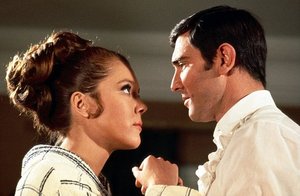 George Lazenby's debut as James Bond in On Her Majesty's Secret Service should have been a bigger deal than it turned out to be. Lazenby was the male model and BP pitchman who, with the help of Sean Connery's tailor and hairdresser, landed the biggest role in British cinema in 1969. What Lazenby lacked in acting chops he made up for in sheer physical prowess and athleticism. No other James Bond has ever been as convincing in close fight scenes as Lazenby was in this film. He gave the impression of a man who really could kill with his bare hands. What acting he had to do, he did well for a beginner. He was a bit stiff in some acting scenes, and someone else had to dub his Sir Hilary Bray dialog because Lazenby couldn't handle the posh accent; but his performance in the final moments of the film was poignant, and, when Bond was in crisis and appeared to be at the end of his tether in the middle of the film, Lazenby conveyed Bond's fear and desperation every bit as well as Roger Moore did at a similar moment in Octopussy. If Lazenby had allowed himself to grow into the role (Cubby Broccoli offered him a five picture deal, which he refused), Lazenby might have grown into a memorable 007. Instead, he ended up, somewhat undeservedly, as the forgotten Bond.
A great supporting cast helps Lazenby out on this adventure. Diana Rigg was an inspired choice for Tracy D'vicenzo. The second Avengers alumnus to take a part in a Bond film (the first was Honor Blackman in Goldfinger, and the third was Patrick McNee in A View To A Kill), Rigg brings wit, style, smarts, and a surprising amout of physical prowess of her own. It's easy to see why Bond thinks her character is special. Telly Savalas is the best of all the actors who played Ernst Stavro Blofeld, giving a sinister, tough performance as the snobbish, social-climbing, ruthless, master criminal. Gabriele Ferzetti plays Draco, Tracy's father and a master criminal himself, with a sly smoothness.
If life were fair, On Her Majesty's Secret Service would have launched Bond in some interesting new directions at the close of the 1960s, but in part because of Lazenby's refusal to continue and in part because box office receipts dropped from 1967s You Only Live Twice, it was not to be. Connery returned for one more outing in the wild, over-the-top Diamonds Are Forever, then it was time for Yaphet Kotto and his partner, Death Incarnate, to threaten former Saint and new 007 Roger Moore in the blacksploitation influenced Live and Let Die. That'll be next.
(Bitterspice has another take on On Her Majesty's Secret Service here.)
Underneath the Mango Tree
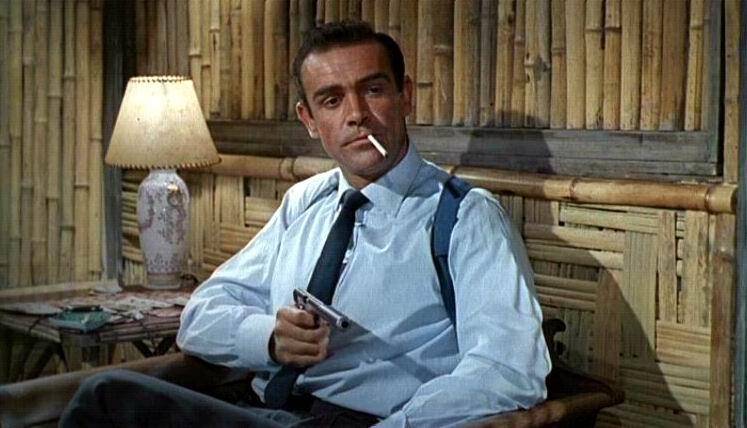
In preparation for the opening of Casino Royale, I've taken it upon myself to watch the other five James Bonds in their debut films. The first up, tonight, was Dr. No. The film is an oddity among the Bonds, because so many of the elements that we've come to expect from later 007 pictures weren't in place for this one. There's no pre-title sequence, and Bond's walk in the gun barrell (done by stuntman Bob Simmons, not Sean Connery), is not accompanied by the familiar John Barry fanfare. The adventure itself is also unusual in the canon. There's only one car chase scene, and it's unspectacular by later Bond standards. Also, while other 007 films emphasize the action and explosions, Bond spends a lot of time investigating in this one.
Connery certainly had a bead on the character even in this early picture. Critics like to talk about what a rough customer Connery was in the films (usually to contrast him with Roger Moore and Pierce Brosnan), but what struck me most about him was his grace and relaxation. In all the Bond films, Connery is the only one who ever sings a charming little tune, and he does it in this picture. I don't recall any of the other actors consenting to a chair dance during their tet-a-tets with Miss Moneypenny. And for all the Connery-Bond's roughness, he makes clear early on that he prefers his Baretta .25 to the 7.65mm Walther PPK, even though Q (this time not played by Desmond Llewellan) disparages the Baretta as a lady's gun. Connery's Bond was masculine enough that he didn't have to prove his masculinity to anyone. It's part of what made him so cool.
It looked like Connery had a ball playing James Bond in this one, and it looked like Bond was having a good time dodging death in the islands. Me too.
On to George Lazenby, Diana Rigg, Telly Savalas and the first great Bond ski chase in On Her Majesty's Secret Service.
Friday, November 10, 2006
Ugh
First Ed Bradley and now Jack Palance. I've crapped bigger than this week. Seriously, thanks, Ed, for all that brilliant reporting on "60 Minutes" and thanks, Jack, for Shane.
Read This Or I'll Sentence You to Life With An Objectivist
Via Ezra Klein, I found an article by Chris Hayes about the flaws in the way lower division economics courses--the ones that drove Neil and me around the bend when we were students seventeen years ago (goddamn! seventeen!)--are taught. All I can add to it is that Hayes's descriptions match my experience of Econ 101 and 102.
When Neil and I took macro, during the Pelopennesian War, our professor was a former hack for then-Senator Slade Gorton. His opening lecture was slightly different from the one Chris Hayes's professor used--our professor compared the free market to the movement of cars on the interstate, explaining that no one tells each car where to go and each driver works individually to achieve his own ends. He didn't explain who built the interstate, or drew all the white lines, or put up the signage, or decided which way the traffic should travel, or empowered the cops to fine or arrest motorists who tried to achieve their own ends too aggressively; but that would have involved taking into consideration the helpful effects of both government and law, which our professor would only have acknoweledged if the alternative had been vivisection. I don't know how many other people saw through the attempt to dress ideology in the clothing of fact during the lectures, but Neil and I certainly did, and it turned me off to the whole discipline.
This was not my experience with other social sciences. My professors in political science seemed able to survey the breadth of the field without making me feel as if I were at Junior Libertarian camp. In Sociology we covered Weber and Marx, but the only tilt I noticed was that we seemed to be reading a lot of Germans. It seems like the distinction here is that while other survey courses try to bring in a mix of theorists for the students to ponder, Econ 101 pretends that the neo-classical economics of Milton Friedman is the only functioning theory of economics that anyone takes seriously, and that its policy recommendations are always correct. This does double harm. Many students will emerge from the classes convinced that the normative positions that their Econ 101 professors present as truths are gospel (and change their voting behavior accordingly), while others, who might otherwise find economics interesting, become so pissed off that they sell their books back at the end of the quarter and move on to other disciplines. My experience in Econ 101 has left me forever suspicious of economists and the arguments they make, and it needn't have been so.
Read the article. It's a good one.
Wednesday, November 08, 2006
A Good Day
The Democrats have taken one, and possibly both houses of congress. There's a lot of ugliness still to come, and I still see this country as one in enormous political and cultural trouble, but at least this is a step in a more hopeful direction. I wish I could feel good about Donald Rumsfeld's departure, but even if an ostensibly reasonable person replaces him (and I don't think that Robert Gates, who deliberately exaggerated the Soviet threat to please his masters in the Reagan administration, represents that much of an improvement), you have to watch for the people Cheney will stick in as his aides. For all we know, the new guy's assignment may be just to sit there and look respectable, kind of like Powell. I'd pity the man, if I were still capable of pity for anyone associated with the Bushes.
Still, things look better today than yesterday, if only slightly.
Tonight I go to see Waiting for Godot for the first time (on stage anyway). My personal Godots are hope for the future and the Oakland Raiders offense. The Raiders' offense still hasn't shown up, but I think I see, maybe it's...
Tuesday, November 07, 2006
Rrrraaawrrrr!
Your results:
You are Hulk
| You are a wanderer with amazing strength.  |
Click here to take the "Which Superhero are you?" quiz...
K-Fed and Britney Are Over
This means that the talentless but insanely fertile Federline is on the loose again! Women everywhere flee in terror! It's a bug hunt, man! Game over, man!
Monday, November 06, 2006
So What's Going to Happen Tomorrow?
I don't know about nationally. After three straight election heartbreaks, I won't feel happy until every last race is called. Indeed, if the Democrats should manage to pull this off, I still won't be happy, because I know that the Bush people, the Fox News guys, and their various right wing minions, will be even uglier in defeat than they are in majority. (See Clinton Administration, The) You can count on Nancy Pelosi being accused of at least ten counts of drug/prostitute related ritual witchcraft slayings, Harry Reid being called a mafia-don, crypto-terrorist, baby slaughterer. And that'll be before Ann Coulter has opened her mouth. That's the fun we're in for, if we win.
Still, locally, the citizens of Washington state will do their part. My calls:
Senate:
Cantwell defeats McGavick:
McGavick was a crummier candidate than a lot of local pundits thought he was, having stepped into a pile of his own shit with that DUI thing last summer. His main problem, though, was that he didn't have an issue. He started out arguing for better relations between our state and Alaska, which allowed Cantwell to say that instead of worrying about pleasing Ted Stevens, she was in there pitching for her state. McGavick than tried to attack Cantwell on the grounds of general niceness--a hard attack to make against a small, shy woman with a quiet voice. Then McGavick started in on the Mexicans and estate taxes, which nobody but the 38% of Washingtonians who already vote Republican were going to get all that excited about. In the end, he tried to argue that because Cantwell's position on Iraq had been inconsistent, that his equally hard to decipher position would be preferable. In my weaker moments, I came within about a half-mile of pitying McGavick. But he's fucked, so fuck him.
Washington 8th:
I have no idea who's going to win this. I've seen polls with Democrat Darcy Burner up, but this is Washington's 8th, Republican district for as long as I can remember. And while I think Dave Reichert hurt himself by getting a school bus driver fired for flipping the bird at the President, I'm not sure how much it hurt him. This one may not be decided before Wednesday morning.
Washington 5th:
Goldmark, the Democrat, has run a good race, and this is the sort of year where a Democrat running a good race in Spokane just might have a shot. Still, it is Spokane and its right-leaning environs, so I'd say the incumbent, Cathy McMorris, still has an edge.
Everyone other member of congress in the state is safe.

Has James Bond Lost His Cool?
I understand that the early British press reviews for Casino Royale have been positive, but after having watched the trailer and read the article I'm still concerned about the direction they're taking the character:
Several reviewers noted one joke that deliberately breaks a Bond tradition. When asked if he wants his vodka martini shaken or stirred, Craig replies: "Do I look like I give a damn?"
Now of course I don't know who Bond is supposedly saying this to, but the response seems like a graceless bit of posturing--see how rough and tough I am in comparison to that wuss...um...Connery. It lacks what to me is central to the appeal of the Bond character: cool.
Cool is no mean trait. It reflects a feeling of ease, of sensuality, of joy in living. Cool makes it possible for the character to do what he must to hold our interest. Cool makes us all want to be James Bond. It's what separates James Bond from Jack Bauer and Jason Bourne. I can't imagine anyone wanting to be the lead character in 24. Jack Bauer's life looks unendingly painful and unpleasant. (I'll bet even his vacations are taut, nerve-wracking affairs, fraught with moral complications.) Jason Bourne's life seems to be spent holed up in grubby rooms, when he's not causing massive traffic pile-ups. When I watched The Bourne Supremacy, I never once sat up and said, "Boy, that looks like fun." I was too busy thinking, "Gee, it sucks to be you."
The best 007s--Connery, Moore, and Brosnan--all had cool. They wore it differently, indeed, they all seemed to be playing just slight variations on themselves, but that's part of cool. The less successful James Bonds--Lazenby and Dalton--seemed to be trying to be James Bond. They were always pushing and striving and straining. Everything they did, even ordinary movement, seemed to involve effort, like novice dancers who have to count the steps out loud. Connery, Moore, and Brosnan simply were Bond. They knew the moves.
Does Daniel Craig have cool? I guess it remains to be seen, but what I hear is not promising. Maybe the Broccolis should have taken Quentin Tarentino up on his offer to do Casino Royale for them. There is a filmmaker who could give master classes on how to manufacture violent, dark cool.
Tuesday, October 24, 2006
Know Your Sith Lords
Dick Cheney said that his critics think he's Darth Vader. Certainly not. Lord Vader was once a good person. A more appropriate Sith Lord comparison would be to one who used fear and lies to boost himself a level of power that was nearly despotic: Darth Sidious. I realize that this analogy is imperfect as well. Sidious had, at least, a superficial charm. While I can accuse Cheney of a great deal, unctuousness and smarm have never been among his crimes. Cheney is a taciturn, charmless killer, and a more apt movie villain analog for him might be Karl Stromberg from The Spy Who Loved Me or Jame Gumb from The Silence of the Lambs, but, as long as we're playing in George Lucas's ballpark, Darth Sidious will have to do.
As for George W. Bush, well, he doesn't get to be Lord Vader either. Whenever someone failed Vader, Vader killed him. Bush keeps promoting his incompetents. Maybe we can cast Bush as one of those Trade Federation guys that Vader wipes out in Revenge of the Sith. They were malicious, vain, ignorant, and given to trusting the wrong people. If we could leave Lucas behind, and if Bush developed better taste in clothes, we might just be able to compare Bush to Brett Easton Ellis's Patrick Bateman. ("I like to torture Arabs. Do you know I'm utterly insane?")
Or maybe Bush is Max Cady or maybe...
This is making me sad.
Friday, October 20, 2006
What Losing Means
Matt Yglesias has a great post about how it's impossible to separate military outcomes from policy outcomes, using Tet as an example:
The Tet Offensive did not, on its own, accomplish any of those things. It did, however, achieve major strides in that direction. It was, therefore, a success. It wasn't a "military" failure but a "political" success, it was just a success.
Read the whole thing. It's very nicely stated. And remember it the next time someone says the Iraq War (or the Afghan war for that matter) was a military success but a political failure. They were neither.
Wednesday, October 11, 2006

Sunday, October 08, 2006
A Saner Relationship With Sports
The Oakland Raiders lost again today, 34-20 to the San Francisco 49ers. It was ugly. The Raiders once again gave up a halftime lead, committing turnovers and losing any sense of rhythm. Ah, well. So it goes. For the next few months, I'll root for Peyton Manning and the Colts. It's more fun. I'll leave the Raiders to get on with the losing it seems they have to do, checking in occasionally to look for signs of improvement.
I mention this because of the exaggerated sense of disappointment that I'm picking up from some quarters of Raider fandom. To a degree, I understand fannish anger at what looks like a another lost season in which the Raiders have, if anything, regressed from the Kerry Collins era. We all still remember the Gannon years, which were simultaneously great and tragic in ways that only the Greeks could chronicle. At the end of that era, the Raiders got old fast. They lost too many players (Gannon, Rice, Brown, Romo, Garner, Parella, Adams, Barton, Rod Woodson, Charles Woodson, and others), and the ones playing underneath them were in no position to just pick up and carry on. Attempts to reload fizzled partly because any plan that requires Kerry Collins to play consistent football indicates a need for a new plan, but mostly because at the core--the offensive line and the defensive front seven--the Raiders no longer had the players to compete week-to-week. Those kinds of problems can't be fixed with high profile acquisitions. They require good scouting, good coaching, and consistent dedication to getting the little things right. Until the offensive line plays as a unit, and the defensive line and linebackers can play with both aggression and awareness, not much else will matter for the Raiders.
Now I could go over all the things the Raiders need to do in order to become a competitive team again. (I'd say prepare for a youth movement, which to a large degree has already started, because with the rising salary cap, I don't think the Raiders will be able to snag too many flashy free agents in the next few years.) But none of that really matters. I don't run the Oakland Raiders, and no one in the organization is listening to me. (And why should they listen, really? What the hell do I know about running a football team?) Instead, I want to put in a word for sanity, a plea to relax for your own sakes and to find the courage to let the Raiders go, at least for a while.
Quoting George Carlin:
You know the best thing I did for myself during the past five years? I told sports to go take a flying fuck. I was fed up with the way I related to professional sports, so I reordered the relationship on my own terms. I became a little more selective.
I couldn't believe how much time I had wasted watching any old piece of shit ballgame that happened to show up on TV. I must have thought there was some inborn male obligation to tune in and root every time a bunch of sweaty assholes got together to mix it up in a stadium somewhere.
I also realized I was wasting perfectly good emotional energy by sticking with my teams when they were doing poorly. My rooting life was scarcely better than those Cubs fans who think it's a sign of character to feel shitty all the time. It's absurd.
I decided it's not necessary to suffer and feel crappy just because my teams suck. What I do now is cut 'em loose for awhile. I simply let them go about losing, as I go about living my life. Then, when they've improved, and are doing well once again, I get back on board and enjoy their success. Yeah, I know, I can hear it: diehard, asshole loyal sports fans screaming, "Front runner!" Goddamn right! Don't be so fuckin' juvenile. Teams are supposed to provide pleasure and entertainment, not depression and disappointment.
I can't improve on what Carlin said right there. Folks, the Raiders are going to have to do some losing. Let's hope it's not too long a dark period, but it might be. There's a lot of work for Art Shell to do. (And I actually think that, irrespective of this year's record, Shell should stay. The Raiders do not need to waste another season bringing in yet another head coach to switch everyone around all over again, though a new offensive coordinator might be a fair idea. Vermeil and Gibbs were allowed to survive their disasterous first seasons, and got much better results after a year or two, despite working for owners who were every bit as out of it as Al Davis is now said to be.) Building through the draft and getting a system fully ingrained takes time. If you want to watch in order to see how it's coming along, fine, but don't expect much, and don't let the failures ruin your week. Find some other pastimes to tide you through. There's a big world beyond the gridiron. Now's your chance to go find it.
Saturday, October 07, 2006
As Close As You Can Get To Pissing Me Off
Just a small thing that's bugging me, gang:
Lexus commercials, already given to using the odious construction "certified pre-owned" in place of used, are now claiming that their "certified pre-owned" vehicles are the closest thing you can get to a new car. No, you hustling prick, the closest thing I can get to a new Lexus is a new Lexus. New means unused. All used cars are equally far away from newness. That's why the instant you drive the car off the lot, they won't let you trade it right back in for full value. Try the "closest thing to a new Lexus" line on the car salesman after you've driven the car off the lot and see how far you get. He'll say, "Bullshit, that fuckin' car is used, but can I interest you in this pre-owned vehicle? It's the closest thing to new!"
Wednesday, October 04, 2006
Embracing Unpopularity
I caught Dennis Miller on Jon Stewart last night. Miller started out funny, but when the subject turned to the administration he embraced a view that I once assumed Miller would be smart enough to see for the rubbish it is. I can't quote it, but it went something like this: yes Bush was unpopular, but Miller discovered through his reading that two other presidents, Lincoln and Truman, were unpopular, and history judged them kindly. Stewart seemed slightly skeptical of the comparison, but Miller insisted on holding to it.
Dennis, Dennis, Dennis, the old you would have seen through the logic of this idea as if it were used Neutrogena. Schopenhauer expressed Miller's sentiment this way: "All truth passes through three stages. First, it is ridiculed. Second it is violently opposed. Third, it is accepted as being self-evident." The more popular variant is, "They laughed at the Wright Brothers". True, but, as Carl Sagan pointed out, they also laughed at the Marx brothers. It's not true that all truth is ignored or ridiculed before it is accepted. Einstein's theories were neither ignored nor violently opposed. Nobody gunned for Achimedes or Da Vinci. (Actually, a soldier, looting the city where Archimedes lived, did kill him; but the soldier had no idea who Archimedes was.) Madam Curie's only enemy was the element she discovered: Radium.
Besides, many promoters of ideas are either violently opposed or ignored because they deserve it. Yes, people laughed at the Wright brothers, but they also laughed at the hundreds of other cranks and would-be inventors who promoted their ridiculous attempts at flying machines. Yes, Lincoln and Truman were unpopular in their eras but vindicated by history; but consider for a moment Nixon, Harding, Buchanon, Hoover, Andrew Johnson, Bush ancestor Franklin Pierce or Bush the First for that matter. All did things (or failed to do things) in office which made them widely disliked in their time, and history has decided that these men earned their imfamy.
A thing to bear in mind if you come in for public criticism--people may laugh at or attack you because they can't accept how right you are; but you must consider that they also may laugh at or attack you because you're either really fucking funny or dangerously wrong. Dennis Miller, much like his friend George W., is stuck on option A, unwilling to consider the (much more likely) option B.
Honestly, Dennis, do you seriously believe that historians are going to look back at the botched response to Katrina, the hideously mismanaged and horribly misconceived Iraq War, the massive public debt and corporate scandals, the torture and the killing, the rapid diminution of personal liberty and privacy, the degredation of the Atlantic alliance and the foreign policy order of the last half century, the ruin of America's image in the world as a good-faith and rational actor in world affairs, and conclude that there really was a pony under all this shit? If you can believe that, I have to wonder what President Bush would have to do to curdle your faith in him.
Tuesday, October 03, 2006
Crisis Over
Well, for anyone still listening out there, the fiscal crisis that made the last four months a valley of woe has abated. I'm not rich, but I'm no longer counting coins every time I have to buy milk at the store either. This experience didn't kill me, but the stress of it probably took a few years off my life. (Of course, if the Republican regimes continue, it's not like I'll want them back.)
It is good to know that under the stress I can still be productive. I should be able to start submitting Escape Velocities in a month or two. I also finished my new action/adventure screenplay, which isn't too far from ready to mail. Matt Damon and Ed Zwick fucked me on the title I wanted to use, so I'll have to think of something else to call it. Damn you, Damon. Damn you and your progeny to the deepest icy bowels of Hell, you miserable Oscar-winning, math promoting, Project Greenlight producing son of a bitch! I'm sorry, but Blood Diamond really was a fucking good title. Anyway, I see Christian Bale in the lead; bitterspice is pushing Aaron Eckhart.
For my next trick, I'll get myself arrested by the administration and see if I can manage to continue high-level literary production while being imprisoned and tortured in Eastern Europe.
Wednesday, September 20, 2006
He Is Not
I've been away for a while, I know, (regular posting will begin again once bills are paid and more important work accomplished). Still, I wanted to take a moment to counter this outrageous slander by Hugo Chavez of Venezuela:
Venezuelan President Hugo Chavez took his verbal battle with the United States to the floor of the U.N. General Assembly on Wednesday, calling President Bush "the devil."
Mr. Chavez, I expect a retraction of this statement immediately. George W. Bush is most certainly not the devil.
The devil is smart.
Saturday, September 02, 2006
Things that Make Me Smile
Mike McGavick, he of the media confession, apparently lied about just how drunk he was when he was arrested for DUI. The Seattle columnists who congratulated McGavick for his reflectiveness are now pissed.
I never actually gave a damn about his confession. I just assumed he was trying desperately to draw attention to himself and a campaign that never had a compelling reason for being. (Is anybody in Washington State really worried because Maria Cantwell and Alaska Senator Ted Stevens don't like each other? In a fight between the two, half the state would root for Cantwell, and the other half would jump in to help her beat up Stevens.) Still, after having logged all this time as a political hack, McGavick ought to know better than to lie about something that the press--or anyone with time on their hands to file public records requests--can easily find out about. Who does McGavick think he is? George W. Bush?
The strange case of Lee Siegel, the ex-TNR blogger, is another thing that made me smile today. Apparently Mr. Siegel, who spent much of the summer hurling the word "blogofascist" like a single-A pitcher with no command, has been suspended from TNR for sockpuppetry. (Sockpuppetry is the practice of signing onto your own blog, under a fake name, and variously seconding your own posts or attacking dissenters.) I've never witnessesed an act of sockpupptry, but I have seen something kind of similar. Check out this user comment for The Mangler 2 on imdb:
Much etter than the first one, 10 January 2002
Author: mhamiltonw from los angeles
A great idea. Nice intro with the female lead, Chelse Swain, who looks great on film. I don't think the other person who commented on this film actually saw the same movie I did. This was fun, hip, and fast paced once the computer virus was downloaded into the school's computer system. I nice DVD rental if you like these kinds of teen thriller "what if" movies.
I grant you, mhamiltonw is not a very good pseudonym for Michael Hamilton-Wright, the film's director, but given the overall quality of his movie, his unimaginative choice of alias is understandable. While Lee Siegel picked a better nom de plume, the overall effect is still to make himself look not only dishonest, but also ridiculous. It's one thing to send yourself birthday and Christmas cards. It's quite another to show them off in public.
During a period where I'm under a lot of economic stress and am often deeply depressed about the state of things, I need stuff like this to make it all worthwhile. Thanks guys. You're wonderful fuck-ups. Whatever you do, don't ever change.
(Hat tip to Majikthise for the Lee Siegel thing.)
Tuesday, August 29, 2006
And While We're On the Subject of Faith Based Delusions
Digby dug this up:
The Presbyterian Church (U.S.A.) has tumbled into a new dispute over the Sept. 11 attacks of five years ago. Its Presbyterian Publishing Corp. has issued "Christian Faith and the Truth Behind 9/11" (Westminster John Knox), containing perhaps the most incendiary accusations leveled by a writer for a mainline Protestant book house. Author David Ray Griffin tells of concluding that "the Bush-Cheney administration had orchestrated 9/11 in order to promote this (American) empire under the pretext of the so-called war on terror."
"No other interpretation is possible," he asserts.
Okay, a few things straight off. I dislike George W. Bush and his band of dour thugs about as much as is psychologically safe (and sometimes a little more, which is why I refuse to watch the man on television). I've no doubt that he's committed many crimes and wrecked many lives. Still, I don't believe for one second Bush or anyone in his administration orchestrated the 9/11 attacks. My reason: look at the things the administration has tried to orchestrate over the last six years. If this administration had planned the collapse of the World Trade Center, you could still go to the north tower and get a nice piece of fish at the Windows on the World restaurant. The Bush administration may radiate malice, but eptitude and subtlety are beyond them.
The administration did indeed seize on 9/11 as a reason to launch an imperialistic project, but if 9/11 hadn't happened they'd have found some other reason. By now it should be clear that for the administration and its surrogates the answer to any foreign policy problem on the map, however remote or small, was to invade Iraq and occupy it for a huge amount of time. If a suicide-bombing penguin had blown up a research station in Antarctica, Bush would have rolled the tanks into Baghdad.
The comments section over at Digby seems caught up in the question of whether the Presbyterians, or their publishing imprint, are liberal or conservative. This is neither here nor there. The question is whether the allegations the book is making come even within the neighborhood of truth. The publisher defends the books author by saying that he "applies Jesus' teachings to the current political administration" and presents "an abundance of evidence and disturbing questions that implicate the Bush administration." That's nice, but leaving aside my lack of interest in what Jesus may have thought of George W. Bush's behavior, it doesn't appear that the author's evidence or questions differ all that much from those of other 9/11 conspiracy theorists, who spend more time worrying over apparent weaknesses in the official story (the metallurgy of the buildings, the odd coincidences) than they do building a credible foundation for their own competing theory of how the towers fell. That's not the path to good history (though it does reflect the same habits of mind that produced another religious product--intelligent design), and it's not the way to discredit the administration. Why play around with fantasy when the facts are bad enough?
The Grimmer Side of Believing in Magic
According to this L.A. Times article, the rise in fundamentalist Christian theology in the Sudan has helped lead to an ugly new variant of an old phenomenon, accusations of witchcraft against children:
On a continent where belief in black magic and evil spirits is common, witch hunts are nothing new, usually targeting older, unmarried women. But in the Democratic Republic of Congo, there's a new twist to this ancient inquisition. A majority of those said to be involved in witchcraft and sorcery are children, and such allegations against them are the No. 1 cause of homelessness among youths.
Of the estimated 25,000 children living on the streets of Kinshasa, the capital, more than 60% had been thrown out of their homes by relatives accusing them of witchcraft, child-welfare advocates say. The practice is so rampant that Congo's new constitution, adopted in December, includes a provision outlawing allegations of sorcery against children.
A rise in religious fundamentalism, revival churches and self-proclaimed prophets is one cause. More than 2,000 churches in Kinshasa offer "deliverance" services to ward off evil spirits in children, the group Human Rights Watch says.
"Some prophets who run these churches have gained celebrity-like status, drawing in hundreds of worshipers in lucrative Sunday services because of their famed 'success' in child exorcism ceremonies," the group said in an April report.
The article goes on to say that poverty and social dislocation are other causes of this phenomenon, but they're hardly mutually exclusive. Fundamentalist dogma tends to gain appeal during times of great social or economic stress, because of the certainties it offers and because of the way it grants frustrated and angry people a means of externalizing and personifying the miseries that beset them. Did your crops fail? Do your feet hurt? Are your cows sick? Find a witch.
When witchcraft or satanic abuse accusations are thrown around, they're usually aimed at those least able to defend themselves. Women, immigrants, poor people, slaves, and children have been, and will always be, targets.
Take these examples from European history (courtesy CSICOP):
Milan, Italy, 1630
British journalist Charles Mackay (1852, 261-265) described a poisoning scare that terrorized Milan, Italy, in 1630, coinciding with pestilence, plague, and a prediction that the Devil would poison the city's water supply. On one April morning people awoke, and became fearful upon finding "that all the doors in the principal streets of the city were marked with a curious daub, or spot." Soon there was alarm that the sign of the awaited poisoning was at hand, and the belief spread that corn and fruit had also been poisoned. Many people were executed. One elderly man was spotted wiping a stool before sitting on it, when he was accused of smearing poison on the seat. He was seized by an angry mob of women and pulled by the hair to a judge, but died on the way. In another incident, a pharmacist and barber named Mora was found with several preparations containing unknown potions and accused of being in cahoots with the Devil to poison the city. Protesting his innocence, he eventually confessed after prolonged torture on the rack, admitting to cooperating with the Devil and foreigners to poisoning the city and anointing the doors. Under duress he named several accomplices who were eventually arrested and tortured. They were all pronounced guilty and executed. Mackay states that "The number of persons who confessed that they were employed by the Devil to distribute poison is almost incredible," noting that "day after day persons came voluntarily forward to accuse themselves" (264).
Lille, France, 1639
Mackay (1852, 539-540) reports that in 1639 at an all-girls' school in Lille, France, fifty pupils were convinced by their overzealous teacher that they were under Satanic influence. Antoinette Bourgignon had the children believing that "little black angels" were flying about their heads, and that the Devil's imps were everywhere. Soon, each of the students confessed to witchcraft, flying on broomsticks and even eating baby flesh. The students came close to being burned at the stake but were spared when blame shifted to the headmistress, who escaped at the last minute. The episode occurred near the end of the Continental European witch mania of 1400 to 1650, when at least 200,000 people were executed following allegations of witchcraft.
Wild stuff, isn't it? People who believe in religious teachings often like to claim that it's hard to be moral without religion. I, conversely, think that the real bitch is to be moral with it.
Thursday, August 24, 2006
A Revelation
Mike! McGavick revealed today that he once drove drunk, and did several other things he wasn't proud of. He has yet to reveal why he thinks it would do anyone any earthly good to vote for him.
Wednesday, August 23, 2006
Wittman's Wake
McCain the center the awful awful awful liberals that attack my islamo-quack-quack-quack North Korea little man like Saddamedamgorgonzola glad he's gone but islamic fascism HitlerHitlerfofitlerbannanafannagogitlerfififofitlerhitler goosestepping over Arabia--Aarby in a world where Irish teenagers sneak out to visit bizarrebazaars and the merchants (of death) with the houkas I slept with a houka once she charged me ten dollars and was gone in puff of smoke ha ha ha ha Lieberman why oh why do they dislike people who hate them don't they know I hate them for their own good Saddam hated Iran who hated Osama so why do they wait dangerously close to asking a question a question don't question my heart Teddy Roosevelt had a big heart unless you were an atheist but they don't count for anything anyway they're part of that conspiracy conspire inspire up up up swingingonastarandspringingfromasponge into space on to heaven with Holy Joe and marvelous marvelous marvelous me.
Monday, August 21, 2006
The Reason Why You Can't Take Toothpaste On a Plane
This is how easy it is to blow up a plane by bringing a variety of liquids onboard (courtesy tapped):
Making a quantity of TATP sufficient to bring down an airplane is not quite as simple as ducking into the toilet and mixing two harmless liquids together.
First, you've got to get adequately concentrated hydrogen peroxide. This is hard to come by, so a large quantity of the three per cent solution sold in pharmacies might have to be concentrated by boiling off the water. Only this is risky, and can lead to mission failure by means of burning down your makeshift lab before a single infidel has been harmed.
But let's assume that you can obtain it in the required concentration, or cook it from a dilute solution without ruining your operation. Fine. The remaining ingredients, acetone and sulfuric acid, are far easier to obtain, and we can assume that you've got them on hand.
Now for the fun part. Take your hydrogen peroxide, acetone, and sulfuric acid, measure them very carefully, and put them into drinks bottles for convenient smuggling onto a plane. It's all right to mix the peroxide and acetone in one container, so long as it remains cool. Don't forget to bring several frozen gel-packs (preferably in a Styrofoam chiller deceptively marked "perishable foods"), a thermometer, a large beaker, a stirring rod, and a medicine dropper. You're going to need them.
It's best to fly first class and order Champagne. The bucket full of ice water, which the airline ought to supply, might possibly be adequate - especially if you have those cold gel-packs handy to supplement the ice, and the Styrofoam chiller handy for insulation - to get you through the cookery without starting a fire in the lavvie.
Once the plane is over the ocean, very discreetly bring all of your gear into the toilet. You might need to make several trips to avoid drawing attention. Once your kit is in place, put a beaker containing the peroxide / acetone mixture into the ice water bath (Champagne bucket), and start adding the acid, drop by drop, while stirring constantly. Watch the reaction temperature carefully. The mixture will heat, and if it gets too hot, you'll end up with a weak explosive. In fact, if it gets really hot, you'll get a premature explosion possibly sufficient to kill you, but probably no one else.
After a few hours - assuming, by some miracle, that the fumes haven't overcome you or alerted passengers or the flight crew to your activities - you'll have a quantity of TATP with which to carry out your mission. Now all you need to do is dry it for an hour or two.
The genius of this scheme is that TATP is relatively easy to detonate. But you must make enough of it to crash the plane, and you must make it with care to assure potency. One needs quality stuff to commit "mass murder on an unimaginable scale," as Deputy Police Commissioner Paul Stephenson put it. While it's true that a slapdash concoction will explode, it's unlikely to do more than blow out a few windows. At best, an infidel or two might be killed by the blast, and one or two others by flying debris as the cabin suddenly depressurizes, but that's about all you're likely to manage under the most favorable conditions possible.
So here's the plan, we're going to make airport security an even bigger time-waster than it already is to avoid even the slightest chance that a terrorist can bring his plan to its likely fruition--an unholy, smelly (and quite exothermic) mess in a toilet. (The whole process sounds so delicate that one good bump would either blow our terrorist up or force him to start over.) Instead of confiscating everyone's soda and mascara, wouldn't we be better off just making a common sense rule that you can't take the champagne bucket into the john? That would stymie the terrorists without inconveniencing any but the fussiest first-class passengers.
My guess is that the London terrorist plotters are kind of like that shoe-bomber; they're people that the real terrorists don't feel too bad about losing because they're kind of stupid and given to plans that they probably stole from an episode of Get Smart. Terrorists don't need to take out planes. There are lots of crowded places for them to wipe out--malls, sporting events, titty bars, subway platforms, hotel lobbies, music festivals. The list is endless. One thing they might do, as sort of a clever bank shot, is set up some shitball terrorist wannabes in Washington. They'll get them to concoct some overly complicated and stupid scheme to blow up an airliner, let the FBI catch them, wait for the media freakout and the predictable TSA clampdown on somethingorother, then send some suicide bombers to what should be a very long, snaking, out-of-control airport security line. The loss of life would be horrific, of course, but on some level you'd have to smile at the irony.
But knowing the security mind as I do, they'd probably start making us stand in security lines to get into the security line. We'd all be nude, of course, to better facilitate the cavity search that would await us at the gate. I'm sure passengers will take it in stride (actually it's hard to take a cavity search in stride, but I'm sure we'll do what we can) because what price peace of mind?
Sunday, August 20, 2006
Free Booze
Majikthise has a line on a wine offer for bloggers, specifically a free bottle of 2004 Amilie Cabernet Sauvignon-Merlot.
Click here for the rules.
Saturday, August 19, 2006
Five Crock of Shit Quotations
Heard about this from Kevin Drum. I'll play:
I pay no attention whatever to anybody's praise or blame. I simply follow my own feelings.
Wolfgang Amadeus Mozart (1756 - 1791)
Not such bad advice if you're Mozart, but pretty crummy advice if you're George W. Bush.
I can't think of any sorrow in the world that a hot bath wouldn't help, just a little bit.
Susan Glasee, The Visioning, 1911
Human Rights Watch says some prisoners in Uzbekistan might disagree with you, Susan.
Forgive many things in others; nothing in yourself.
Ausonius
Rubbish. Following this advice is a recipe for neurosis.
Political advertising ought to be stopped. It's the only really dishonest kind of advertising that's left.
David M. Ogilvy
Spoken like a man preparing to sell something. Orwell pretty much hit it when he said that all propaganda lies, even when it's telling the truth.
It is as hard to see one's self as to look backwards without turning around.
Henry David Thoreau (1817 - 1862)
Henry, meet the mirror.
Tuesday, August 15, 2006
Sillius Sodus
I'm not generally given to reading Rabbi Gellman, but thanks to Atrios I couldn't avoid him. Of all the takes I've seen on Joe Lieberman's collapse that were not uttered by the candidate himself or one of his few remaining flunkies, this wins the Palm D'or for fatuous punditry:
Please understand, this is not a political rant. Yes, I support the war and yes I support and admire President George W. Bush, but I understand and respect those who have come to another conclusion about how best to fight the war on terror. My disappointment is with my people. I simply do not understand why so many Jews bailed on Joe. I cannot understand why Joe's percentage of the Jewish vote was not in the high 90s instead of the 54-57 percent range (according to Lieberman’s campaign). I have opinions on way too many things I don't know nearly enough about, but I know about Jews. I am a professional Jew, and yet if you asked me to explain why Jews did not vote for Joe the way blacks voted for Barack Obama or Catholics voted for John F. Kennedy I would not know what to tell you.
In truth I am also bewildered about why Jews do not support President Bush more than the pathetic 22-26 percent (depending on which exit poll you look at) he received in 2004. Bush would win a landslide in Israel, and never once invited Yasir Arafat to the White House, but that is a bewilderment best left for another day. What has frozen me is the lack of support for Joe by Jews. Joe voted the Democratic line 90 percent of the time. Twenty-nine other Democrats also voted for the war and none of them was targeted (yet). Joe is the most famous Jewish politician of all time (unless you count former New York City Mayor Fiorello LaGuardia whose mother was Jewish). He is an observant Jew and obviously he was on the presidential ticket in 2000. He is modest and self effacing. He is moral and faithful. He is principled and intelligent ... and he is one of us! What more do you want of the guy?
Well, leaving aside the hyperbole of Joe Lieberman as the most famous Jewish poltician of all time (I didn't know he beat out Golda Meir and Yitzak Rabin), the rest of Gellman's argument rests on a fundamental misreading of U.S. politics. Voters in the U.S. don't vote strictly along ethnic or religious lines. U.S. catholics did vote for John Kennedy, but split pretty heavily when it came to the other JFK, John Kerry. Yes, Barak Obama won the vast majority of the black vote in Illinois, but a white candidate would have probably done just as well among black voters because even though the republican in the race was black, he was also a raving lunatic.
Ethnic voters living in this country are not going to necessarily vote the same way, or for the same reasons, as people who live in their country of origin. Pakistanis in London don't see issues the same way as Pakistanis in Islamabad do. And I'm sure U.S. Jews see issues differently from Israeli Jews, Russian Jews, Polish Jews, Canadian Jews or Ethiopian Jews. The politics of any diaspora is complicated, with generational, regional, and religious dimensions. It can't be reduced to "he's one of us" because it begs the question of who "we" are.
It is possible that many Israeli Jews would vote for George W. Bush (and they can have him if they want him). Israeli Jews didn't live anywhere near Hurricane Katrina. They haven't had to put up with stagnant wages, jobless recoveries, "Kenny Boy", or Guantanamo. Their tax dollars and their kids aren't being shipped off to the blood and money pit of Iraq. There are a lot of things going on in this country that are not their problem. So they may just look at him and see a man who supports Israel. Fine. But U.S. Jews, QED, have to live here. They get a closeup view of Bush, and many of them apparently don't like what they see. And I guess they don't much care for politicians, Jew or Goy, Democrat or Republican, who make a habit of parroting the President's talking points.
Now, a few parting shots. "He [Lieberman] is modest and self effacing. He is moral and faithful. He is principled and intelligent..."
"Modest and self effacing": I really have to question whether a man who abandons his party after losing a primary to run on the ticket of "Connecticut for Lieberman" is either.
"Moral and Faithful": I know nothing about Lieberman's marriage, and if that's all Gellman is talking about I'll provisionally take "faithful". But Lieberman doesn't seem that faithful to his party, his colleagues, or to his youthful ideals. He'll jettison those the moment his career is threatened. (Once upon a time a young staffer for McGovern became a politician. He lost a race somewhere along the line--beaten up for being too liberal. So he, well, you know the rest...) As for "moral"--again, as long as it's a question of whose sex organs interact with whose, I'll accept the word. But Lieberman's backing of Alberto Gonzales's archipelago of torture farms, and his willingness to throw downfield blocks for people who lied us into a war don't sound moral to me.
"Principled and Intelligent." I think we've sufficiently covered Lieberman's principles. As for his intelligence, one need only look at the campaign he ran against Lamont to see Lieberman is completely blinkered and out of his depth. He can't really defend his views convincingly, and propounds ideas that six-year-olds could see through. Osama is really more evil than Hitler and more dangerous than the Soviets, Joe? A vote for Lamont is a vote for Osama? Only an idiot would think that, or in Lieberman's case, a principled, intelligent, useful idiot.
Maybe I'm just spitballing here, but I'm guessing that around 43% of Jews in Connecticut noticed some if not all of the things I've noticed about the erstwhile Democrat, and decided Joe Lieberman wasn't "one" of any "them" that they wanted to be associated with. I hope this cures your bewilderment, Rabbi Gellman, for a few minutes anyway. Good night, and good luck.
Monday, August 14, 2006
New Blog
Now that football season is nearly upon us, I have a new, all-Raiders all-the-time blog called The Raider Diaspora.
Tuesday, August 08, 2006
Vote
If you're from Connecticut, a registered Democrat, and here because your dryer is squeaking (it's probably either the belt or a missing screw in the bearings--either way, easy fix, don't panic), get out and vote for Ned Lamont. You'll have whiter teeth, fresher breath, fewer cavities, and sexier, tighter abs to attract whichever gender you prefer to fuck. Well, okay, but you'll at least pull a pretty nasty thorn from your side, and that's sure to make you feel better.
So vote, and call someone about the dryer. It's a cheap fix. Really.
Sunday, August 06, 2006
Howard Johnson's Right About Olson Johnson's Being Right
Kevin Drum quotes from a Publius post that says that, while the blogs actually weren't at the center of Joe Lieberman's political problems, Lieberman's supporters are hell bent on making it look as though they are. This will, because perception is reality in these matters, make bloggers more powerful in the Democratic party. I doubt this was the effect that guys like Marshall Wittman and Jonathan Chait had in mind when they placed bloggers at the center of the Lamont campaign, but I guess that's how it worked out.
All this will obscure the truth about this race, but I still think that people who care will be able to find it. And when they look, I think they'll discover that it was Joe Lieberman's strategy of aligning himself with right-wing figures over the course of his career--Bill Bennett, Sean Hannity, and (though Lieberman has at times disputed it) George W. Bush--that ultimately led to his downfall. Now I know that Lieberman's remaining supporters will protest "But that's not the real Joe Lieberman!" But, in these matters, as Joe Lieberman forgot when it counted, perception is reality. It looks like that mistake will cost him his career.
Someone (I suspect Lanny Davis but I could be wrong) said of Joe Lieberman that he doesn't think politically. I'm sure he meant that as a compliment, but watching Lieberman flail through this primary against a rookie I can't help but think that a politician not thinking politically is a bit like a scientist not thinking scientifically or an athlete who doesn't think athletically. It's a good idea for a politician to appear apolitical, but underneath it there must lurk a shrewd political mind that monitors both enemies and friends and keeps close track of where the best political ground is located. Both Hillary Clinton and Maria Cantwell avoided serious primary challenges because they kept watch on local party officials during their tenures, stopping potential rivals before they could start, and because they knew when to throw the base a bone or two. If only Joe Lieberman had their sense. Too bad. So sad. Fuck him.
Saturday, August 05, 2006
Joementum Defined
Joementum. n. A state or condition in which the identity of the loser is known to all observers of a contest except the loser, who believes he's winning. [ORIG: A speech by Joe Lieberman in which he claimed to be surpassing his rivals in the 2004 New Hampshire Primary. He ended up finishing fifth.]
Thursday, July 27, 2006
I can't help myself
From Salon we get word that Ann Coulter thinks Bill Clinton is a latent homosexual. Here's why:
Her evidence? Well, all those sexual relations he's had with women, of course. "I think that sort of rampant promiscuity does show some level of latent homosexuality," Coulter explained.
Other famous homosexuals (real and in fiction):
1. John Kennedy
2. James Bond
3. Babe Ruth
4. Hugh Hefner
5. Charlie Sheen
6. Wilt Chamberlain
7. Captain James T. Kirk
So just remember kids, if you have lots of sex with members of the opposite sex, it means you're gay. That'll throw a kink in your sexual identity, won't it?
Monday, July 24, 2006
Good For the Foreign Office
I haven't had a lot of cause to say that recently, but this time, they're saying more or less what I've been thinking:
And it's very difficult, I think, to understand the kind of military tactics that have been used. You know, if they're chasing Hezbollah, then go for Hezbollah. You don't go for the entire Lebanese nation.--Kim Howells, British Foreign Office Minister.
Yeah. I'm afraid this is what's been bothering me about the whole mess. Is it really a sensible strategy for Israel (with tacit U.S. encouragement) to devastate Lebanon in order to pursue a cadre of terrorists in the southern part of the country? Doesn't that risk busting up the Lebanese central government and restarting the factional warfare that helped fuel the formation of these terrorist groups in the 1970s and 1980s? Why would Israel want to have that nightmare on their northern borders again? Hell, the Lebanese only recently kicked the Syrians out of Lebanon. Doesn't chaos there form a basis for their coming back in?
Israeli officials, in every interview I've seen, tend to focus on their right to engage in this kind of warfare. They were attacked, they say, and they're responding. Fine. But wouldn't it be better if their response actually brought Israel closer to desirable goals, instead of prolonging the misery and spreading it around?
I don't like the various World War analogies that local opportunists have been spewing in hopes of attracting the stupid vote, but there is one thing that George Kennan said about World War I that seems appropriate. I don't have the book with me, but he observed that World War I was evidence that suffering didn't always make people better, that war frequently gave people the excuse to believe self-flattering lies and imagine only the worst about their adversaries. War is intoxicating stuff, and it looks to me as if the Israeli government is already pretty sloshed.
The New Worst Movie Ever Made
Those who know me know that I have in my time watched a lot of crap. Red Zone Cuba, Amityville 2, Yor, the Hunter From the Future, Outlaw of Gor, Armageddon, Ringmaster, Pearl Harbor, Manos: the Hands of Fate, Glitter, The Lonely Lady, Battlefield Earth--these and many many other horrors have left craters on my retinas at one time or another.
But I have never seen a film so bad, just so unutterably stupid, as Monster A-Go-Go.
Monster A-Go-Go is the story of...hmm. What is it the story of? There's no monster. There's no A-Go-Go, and notwithstanding the protestations of the narrator, there's no horror. What there's a lot of is dark. Indeed, the movie The Dark didn't have this much dark. There are long periods where the screen is literally blank. Sadly, these are the film's better moments.
Essentially, the film consists of a few randomly placed shots of a tall man with oatmeal on his face interspersed with...well...the mind rebels against calling them scenes where characters talk about...actually, it's never quite clear what they're talking about, because the sound guy apparently didn't think that the audience needed to hear the actors. (I'm not sure whether I should condemn or praise him for that.) Characters come and go inexplicably. We never miss them when they're gone. We never really notice when they're there. The activities of Quaker-Oats Man, which are allegedly horrifying, take place largely off-screen. It falls to the various random characters to stumble upon the aftermath of the monster's mayhem and break into indivdual discussion groups to compare findings, which we never hear. In the end, a parade of stock footage tells us that preparations are taking place for something having to do with the monster, but then the narrator informs us that there was never a monster at all! Fade out. The end.
As I said, I'm a crap veteran. I was sure that when it came to cinema, I'd been to the ninth circle of hell, where Satan's three mouths chew on the worst offenders in all of film history: Coleman Francis, Hal Warren, and Michael Bay. But no. The Inferno has a subbasement, where Monster A-Go-Go lives and rolls in the filth of its own wretchedness.
From what I understand, the producer got his mitts on some footage from a movie that ran out of money. He then decided to add some other footage, mix in some stock footage, and run the confection as the bottom half a double feature. I can guess how it went over. It's a wonder he's still alive.
Saturday, July 22, 2006
My My My
According to Political Wire, a Rasmussen poll not only has Lamont ahead of Lieberman by 10% for the primary, but he's also tied with Lieberman for the general election.
I guess there are lots of crazy bloggers in Connecticut.
Friday, July 21, 2006
Mr. Shyamalan, Are You Pondering What I'm Pondering?
I haven't seen Lady In the Water, so don't worry. I can't reveal the twist. But I did find a small measure of amusement in the name he gave his magical being: "Narf".
Mr. Shyamalan, are you by any chance familiar with Pinky and the Brain?
Thursday, July 20, 2006
Nice Try For An Analogy, But I'm Unconvinced
From Bullmoose:
Almost forty years ago, the Moose witnessed a good and decent liberal unfairly slimed by the ideological predecessors of the nutroot blogosphere. In 1968, the New Leftists didn't have the internet, but with their voices they shouted out and heckled Hubert Humphrey with the chant, "Dump the Hump." The Moose will be damned if he stands by while another progressive leader suffers the disgraceful treatment that was accorded the Happy Warrior so long ago.
The progressive leader he's talking about is Joe Lieberman, but before Wittman gets too excited about his analogy, there are a few things that want pointing out. Hubert Humphrey was, for many years, the darling of the left. The appellation of Happy Warrior was placed upon him not for hawkishness, but for his outspoken way of pushing for social programs and civil rights. When Humprey was chosen as Johnson's Vice President, liberals felt like they had a voice inside the administration (particularly important because of the strains between LBJ and Robert Kennedy). Humphrey actually came to oppose war in Vietnam; but Johnson threatened to sink his candidacy for president if Humphrey refused to back his war policies during the 1968 campaign. This lost Humphrey a great deal of support among liberals, who tranferred it first to Eugene McCarthy and then to Bobby Kennedy. When Kennedy beat Humphrey in the California primary only to take a bullet in the head in the kitchen of the Ambassador Hotel afterwards, liberals, already pretty raw after the death of Martin Luther King, were doubly heartbroken. They could hardly be expected to transfer their enthusiasm to Humphrey, who they felt had let them down at the same time that murderers had robbed them of their heroes. It was a sad business all the way around, really.
Lieberman, by contrast, was never what anyone would call a darling of the left. When he's been a happy warrior it's been more often than not (or at least, more famously than not) for conservative issues than for liberal ones. He doesn't seem to like liberals too much, and they don't like him back. I don't think Lieberman actually disappointed anyone with his support of the Iraq War (which I take to be genuine rather than tactical), but it did confirm an opinion that many inside the Democratic party already had of him from his behavior on other issues.
So, Mr. Wittman, nice try, but I'm not buying. Incidentally, you can read more about this topic at Talking Points Memo.
Wednesday, July 19, 2006
Lame Questions Entertainment Reporters Ask
These are some questions that the L.A. Times's Channel Island is nominating for its Jiminy Glick awards (named for Martin Short's bizarro entertainment reporter character):
"Where do you get the bear spray? Where can you buy it?" - To Jenny Bicks, creator of ABC's "Men in Trees," which is set in Alaska
"When using an ATM, do you find yourself getting nervous?" - To the cast and creators of ABC's "The Nine," a drama about the aftermath of a bank robbery
"Do you try to solve mysteries? Like, if you are just sitting watching a mystery movie or something, would you try to figure it out before the credits roll?" - To Kristen Bell, star of CW's "Veronica Mars"
"What makes you really cranky and irritable? Is there anything?" - To the usually perky cooking expert/talk host Rachael Ray
"I'm very serious, looking for a serious answer from you: Have you ever had an experience where you truly felt there was an angel or a higher being looking out after you?" - To Rick Worthy, star of ABC Family's "Fallen," about a character who's half-man, half-angel.
The last one is especially funny. It has that faux-hard-hitting intro followed by a question that makes the actor fear that the reporter is going to whip out a holy book and insist he read marked passages.
Hunh
 When it comes to this moment, I'm afraid I have nothing brilliant. I'm an educated man, but I'm afraid I can't speak intelligently to the impulses that would drive the President of the United States to give a spontaneous, unsolicited massage to a fellow world leader. I do think, however, that before the President strikes again, he might want to remember the story of Tony Rocky Horror.
James Woolcott has a good post on this.
Monday, July 17, 2006
A Strange History
Gregory Rodriguez praises Barak Obama's speech (a speech I actually liked as well), but in doing so he asserts a history of the Democratic party that misses a lot:
That was not always the case. Some scholars point to the Democratic National Convention of 1972 as not only the moment Democrats edged toward secularism but the event that created the religious rift in American politics. Before 1972, both major parties were essentially indistinguishable in their approach to religion. The activist cores of both were dominated by members of mainstream religious groups: the GOP by mainline Protestants and the Democratic Party by Catholics and Jews.
But the Democratic delegation that nominated South Dakota Sen. George McGovern for president at the '72 convention represented a profound shift from what had been the cultural consensus in American politics. Whereas only 5% of Americans could be considered secular in 1972, fully 24% of first-time Democratic delegates that year were self-identified agnostics, atheists or people who rarely, if ever, set foot in a house of worship. This new activist base encouraged a growing number of Democratic politicians to tone down their appeal to religious voters and to seek a higher wall separating church and state. With little regard for the traditionalist sensitivities of religious people within or outside of the party, the Democrats also embraced progressive stances on feminism and homosexuality that the public had never openly debated.
Meanwhile, the Republican delegation — and by extension the party platform — remained unchanged, and the GOP essentially became the party of tradition and religion by default. "The partisan differences that emerged in 1972," writes University of Maryland political scientist Geoffrey Layman, "were not caused by any sudden increase in the religious and cultural traditionalism of the Republican activists but by the pervasive secularism and cultural liberalism of the Democratic supporters of George McGovern."
While I certainly hate to underestimate the power of 24% of Democratic party delegates, the major shift away from the Democrats occurred for reasons largely outside of Democratic party's religious policies. White southerners left the party less because of religion than because of race. Over the same period, blacks, both northern and southern, religious and not, switched overwhelmingly to the Democratic party. In the end, the demographic shift sank Democrats in the South, though it put them on the right side of history. Also, the 1972 Roe v. Wade deicison energized millions of fundamentalists and evangelicals nationwide and drove them into Republican politics, generating enthusiastic support for Reagan against Ford in 1976 and gradually driving moderate Republicans further and further northeast. The Republican delegation did not go "unchanged". It grew far more aggressively conservative through the 1970s and 1980s--so much so that George Bush Sr., known as "Rubbers" in the 1960s for his support of contraception and family planning, had to insist over and over again that he was anti-abortion enough for the GOP right to survive the 1988 primaries. Finally, in 1972, McGovern would never have been the face of the party had not Nixon's men ratfucked McGovern's primary opponents, especially Ed Muskie, the early frontrunner in the '72 primaries who was running ahead of Nixon before the forged Canuck letter sank him.
There have been religious changes in the Democratic party since '72. It's become less Catholic. Southern Baptists of various sorts--you need a program to keep track of the denominations--have grown in influence and power. In the last four Presidential elections we've nominated two all-Baptist tickets, a Baptist/Jewish ticket, and a Catholic/Methodist ticket. While Democratic candidates are typically less given to wearing their religions as if they were Captain Midnight badges, I don't see any effort to wipe out more overtly religious candidates. (Quick, which party was the last one to run an ordained minister as a Presidential Candidate, and from whence on the political spectrum did he run?)
The column's equation of secular left with religious right also ignores a vast difference in power. Religious right politicians hold the White House, the Congressional majority and its leadership, and four Supreme Court seats. Atheists and agnostics control...well...the Skeptics Society, the Socialist Worker party, Bernie Sanders, and, for at least a few years, the Minnesota Vikings's offensive backfield. We don't have the power to push politicians to do anything at all, though I'm perfectly willing to admit that our mere presence in the Democratic party suffices to help the Pat Robertson/Bill O'Reilly types spin conspiracy theories (as do a variety of lawsuits involving coinage and the Pledge of Allegiance that have nothing to do with the Democratic party).
The narrative the column spins--that once upon a time the world was stable and everyone agreed on unifying religious precepts until one day a cabal of evil atheists came and wrecked it all--resonantes deeply in our history. Unfortunately, the places where it resonates are pretty nasty. It would be nice if more religious Democrats would drop this kind of paranoid nonsense. It would also be nice if the Cubs were above .500 and the Raiders had a more solid front seven. Life's a bitch, huh?
If you want more: Digby has it.


